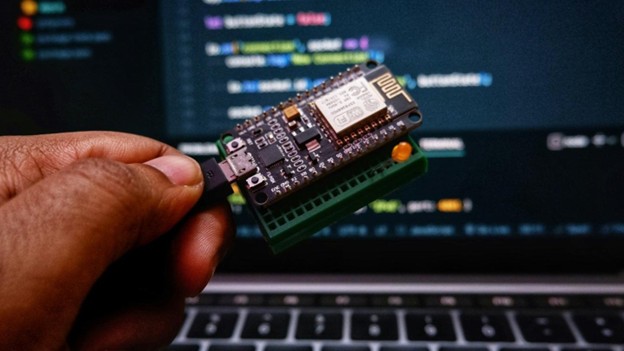
Supply chain resilience now depends on IoT security
Supply chain resilience is increasingly being discussed in terms of logistics diversification, geopolitical risk and operational continuity. However, one issue remains consistently underestimated: modern supply chains now depend heavily on the integrity and security of connected systems.
IoT devices, industrial sensors, edge gateways and machine-to-machine platforms have become foundational to how goods are manufactured, tracked, stored and distributed. As organisations automate operations and rely more heavily on real-time telemetry, IoT security is no longer simply a cyber security concern – it’s an operational resilience issue.
A compromised IoT environment can disrupt logistics flows, corrupt operational data, halt automated processes and undermine decision-making at machine speed.
Operational resilience now relies on trusted telemetry
Real-time visibility is one of the most significant drivers behind IoT adoption in supply chains.
Sensors monitor environmental conditions across cold-chain logistics, GPS trackers provide shipment visibility, and connected industrial systems continuously report equipment status and production metrics. This telemetry enables organisations to optimise routing, reduce waste, predict maintenance requirements and respond rapidly to disruption.
However, as operational decisions become increasingly data-driven, the integrity of that data becomes critical.
If attackers manipulate telemetry streams, the consequences extend beyond traditional cyber risk. False environmental readings could conceal temperature excursions in pharmaceutical or food logistics. Altered inventory or shipment data could trigger incorrect routing decisions or create artificial shortages across distribution networks.
In highly automated environments, corrupted telemetry can rapidly cascade into operational disruption.
This represents a fundamental shift in supply chain risk. Resilience no longer depends solely on redundancy and logistics planning – it depends on whether organisations can trust the connected systems generating operational intelligence.
Securing these environments requires more than basic device authentication. Organisations increasingly need:
– Cryptographically verified device identities
– Encrypted telemetry pipelines
– Secure key management at scale
– Integrity validation for operational data
– Continuous monitoring for anomalous device behaviour
Without these controls, the visibility enabled by IoT can itself become a systemic vulnerability.
Edge computing expands both capability and risk
Many organisations are now deploying edge analytics to reduce latency and improve operational responsiveness. Industrial edge systems can analyse vibration, thermal and power-consumption data directly on production equipment, enabling predictive maintenance models that reduce downtime and improve throughput. Similar architectures are increasingly used across warehouses, transport infrastructure and utilities.
However, edge environments often operate outside traditional enterprise security boundaries.
Unlike centrally managed IT infrastructure, edge devices may remain operational for years in physically exposed or difficult-to-manage locations. Many organisations still struggle with basic asset visibility across operational technology (OT) environments, particularly where legacy infrastructure coexists with newer connected systems.
This creates a growing attack surface.
Compromised edge devices can potentially be used to:
– Manipulate predictive maintenance outputs
– Disable operational equipment
– Establish persistence within OT environments
– Pivot into enterprise networks
– Disrupt automated production systems
Recent attacks against operational environments have demonstrated that cyber incidents increasingly create physical and operational consequences, not just IT disruption.
As a result, securing the IoT device lifecycle has become a core resilience requirement.
That includes:
– Hardware-rooted trust
– Secure boot mechanisms
– Signed firmware validation
– Authenticated over-the-air updates
– Vulnerability management throughout device lifetimes
– Software provenance tracking and SBoM visibility
For many industrial environments, this is particularly challenging because operational devices may remain deployed for 10–15 years while security expectations evolve continuously during that period.
Automation increases the blast radius of compromise
Modern supply chains increasingly rely on machine-to-machine coordination. Warehouse robotics, automated inventory systems, smart manufacturing platforms and logistics orchestration systems continuously exchange data through APIs, industrial protocols and cloud-connected services.
These systems improve efficiency and reduce manual intervention, but they also compress the timeframe in which failures propagate.
A compromised IoT device or insecure API no longer affects a single endpoint. It can potentially influence automated decision-making across entire operational workflows.
Attackers exploiting weak authentication or insecure integrations could:
– Inject malicious operational commands
– Disrupt robotics systems
– Manipulate inventory synchronisation
– Trigger false maintenance events
– Halt automated logistics operations
Because these systems operate autonomously and at scale, disruption can spread far faster than in traditional manually controlled environments.
This is one reason why zero-trust principles are increasingly relevant within industrial and supply chain architectures.
Organisations need stronger controls around:
– Device identity and attestation
– API authentication and authorisation
– Network segmentation and microsegmentation
– East-west traffic monitoring
– Anomaly detection across operational systems
Critically, security teams and operational teams can no longer operate in isolation. Resilience now depends on integrating cyber security into operational continuity planning.
The software supply chain problem is growing
Many IoT security discussions still focus primarily on devices themselves. However, modern connected systems also depend on increasingly complex software supply chains.
Industrial IoT devices frequently rely on third-party operating systems, open-source libraries, embedded firmware components and cloud-based management platforms. Vulnerabilities within any layer of this ecosystem can introduce systemic risk across large device fleets.
The challenge is compounded by the fact that organisations often lack full visibility into software dependencies running inside operational environments.
Regulatory pressure is also increasing.
Frameworks and regulations such as:
– Cyber Resilience Act (CRA)
– NIS2
– IEC 62443
– ETSI EN 303 645
– Emerging SBoM requirements
are pushing organisations toward stronger lifecycle accountability and software transparency across connected products.
This represents an important shift in how resilience is being defined. Organisations are now expected not only to maintain operational continuity, but also to demonstrate that connected systems can be securely maintained throughout their operational lifetimes.
IoT security must be treated as operational resilience
Too many organisations still treat IoT security as a compliance exercise or an extension of traditional IT security. That model is increasingly outdated.
In highly connected supply chains, cybersecurity failures can directly affect physical operations, production continuity, logistics coordination and customer trust. The distinction between ‘cyber risk’ and ‘operational risk’ is rapidly disappearing.
Organisations that approach IoT security strategically – by integrating lifecycle security, telemetry integrity, software transparency and operational monitoring into resilience planning – will be significantly better positioned to withstand disruption.
The organisations that struggle will likely be those that continue deploying connected infrastructure faster than they can secure and govern it.
As supply chains become more automated, interconnected and AI-driven, trusted connected systems will become a prerequisite for operational resilience itself.
Lou Farrell
Lou is the Senior Editor of Computing and Cybersecurity at Revolutionized Magazine, with many years of experience in analysing tech innovations and crafting informative, insightful pieces that aim to educate and empower readers in an ever-evolving digital landscape.